Friday, August 2, 2013

Harris Savides | Los Angeles | 2010

Greenberg (Noah Baumbach)

Somewhere (Sofia Coppola)

Wednesday, June 19, 2013

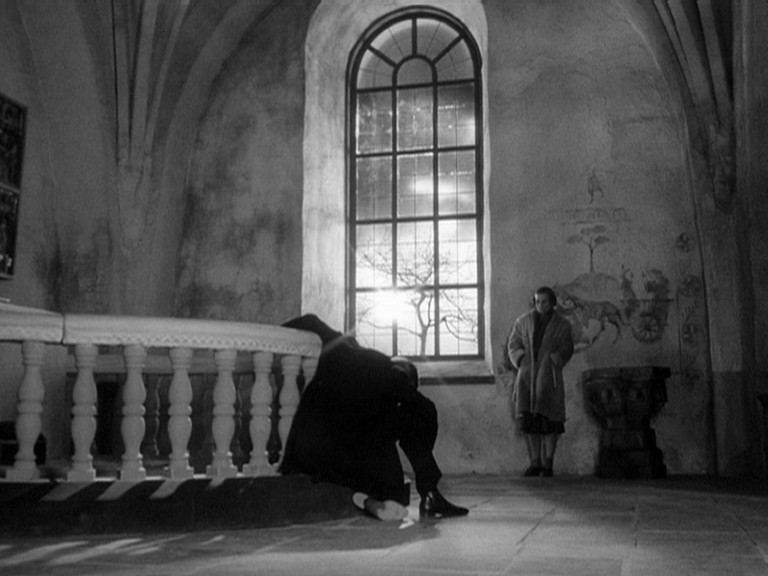
Winter Light (Ingmar Bergman, 1962)


The first thing that struck me watching Winter Light was the precision of the filmmaking. It’s been awhile since I’ve sat down with a Bergman, so my memory could be faulty, but I remember The Seventh Seal, and Wild Strawberries¸ and even Persona (one of my absolute favorites) feeling a bit frayed at the edges. Every edit and every shot in Winter Light seems precisely conceived. The mise-en-scene speaks volumes.  There is no one as talented as Bergman at positioning actors within a frame for effect. It is a much sparser film than the earlier ones often touted as his best, and a much stronger one.

Austerity is fitting for a film about God’s silence. Bergman observes its effects primarily in the tortured faces of his players. During the opening scene in the church, I was consistently drawn to that of Ingrid Thulin. I fell in love with her as Tomas sits down to read her letter. Bergman wrenches every ounce of expression out of her face as he films her staring directly into the camera, sans glasses, reciting her words in a single take. A similarly powerful choice later in the film stages a scene fraught with emotional  torment in front of a raging river, the roaring rapids drowning out the dialogue.

Bergman makes no claims as to whether God’s silence is a choice on the deity’s part or a result of his or her nonexistence. He merely asks that we all, believers and nonbelievers alike, question the courage of our convictions. It’s the uncertainty that troubles Marta in her atheism and Tomas and Jonas in their Christianity. Algot, the sexton, makes the astute observation that the doubt Jesus suffered on the cross, along with the departure of his disciples, must have been inifinitely more harrowing than the physical pain he suffered. He is the only character in the film who has bears the courage of his convictions, having taken Jesus’s directive to express himself with love to heart, and he’s all the better for it.

In Swedish the film’s title translate to “The Communicants.” It bears a double meaning. The opening scene features the films cast accepting communion, but these are characters incapable of articulating their feelings to one another. Algot said when Jesus’s disciples deserted him it must have been painful, realizing none of them had truly understood the things he had said. So it is for Tomas, whose attempt to empathize with Jonas only serves to hasten his demise, who unconscionably excoriates Marta, a woman he clearly cares deeply for. And also for Marta, who insists she is incapable of putting her love for Tomas into words. If only we knew how to communicate better, perhaps the pain of existence would be less acute.

Sunday, April 28, 2013

Upstream Color (Shane Carruth, 2013)


The three best films I’ve seen so far this year (Spring Breakers, To the Wonder, and Upstream Color) all strive to exist as pure cinema, expressions so heavily dependent on the interplay of sound and image for their emotional effect that it is impossible to imagine their survival in any medium other than film. This places them in direct opposition to the other great film I saw this year, Abbas Kiarostami’s Like Someone in Love, which—while undoubtedly cinematic—could easily be conceived as a thoroughly effective short story. The term frequently applied to films like Spring Breakers and Upstream Color (and even To the Wonder) is Malickian, or Malicky, or some derivation thereof. Sure, all these films rely more heavily on emotional than narrative logic a la The Tree of Life, but Spring Breakers is more heavily indebted to Michael Mann, Upstream Color to Cronenberg and Resnais.

Upstream Color is a genuinely beguiling film. On the surface, the plot is relatively straightforward, but the details serve (perhaps unnecessarily) to complicate things. This creates a unique effect. At the same time that you’re being seduced by the sublimely edited sequences, these details nag at you, making you question whether or not the whole enterprise is bullshit. On a thematic level this works, as the characters are being forced to reconsider their identities, the narratives they’ve constructed for themselves. This is Carruth’s primary focus, the frailty of our identities and the degree to which they are shaped by other people and the relationships in our lives.

The growth Carruth has shown as a filmmaker since Primer is astonishing. The direction in that film was not without the occasional flourish, but it was primarily functional, existing in service of the script. Seldom a moment passed that wasn’t driven by dialogue. Conversely, Upstream Color is driven by its direction—the sounds and images and the emotions they convey, and the way they relate to other sounds and images via montage. Large swaths of time flow by with nary a word spoken. The script sometimes gets in the way, serving as the source of the cognitive dissonance described above.

Carruth didn’t doubt the intelligence of his audience in Primer, but in Upstream Color he places a remarkable amount of faith in our visual literacy. Like a painter or a poet, he takes for granted his audience’s ability to piece together a meaning without the artist connecting the dots. It’s not unique so much for what he does as how he does it. Elliptical plots are nothing new, we can point again to Kiarostami’s Like Someone in Love, but Kiarostami gives us text to build upon, Carruth assumes the foundation is already there. Rather than a puzzle box like Primer demanding to be solved, Upstream Color is content to wash over you, trusting that if the plot eludes you the feelings won’t. And in art, the feelings are what’s  important, are they not?

Saturday, April 13, 2013

To the Wonder (Terrence Malick, 2013)


“Other people direct movies. Terrence Malick builds cathedrals”

These words, from Matt Zoller Seitz, occur to me every time I watch a Terrence Malick film. They inevitably contain several moments that are transcendent to a degree that can only be described as religious, so removed from what conventions have taught us to approach as cinema that the moniker of “movie” seems somehow to diminish them. Where the majority of movies are inherently theatrical, Malick consistently rises above such constraints. He writes symphonies, directs ballets; he paints with light. Malick may not be my favorite director, but, in a person, he represents cinema’s innate potential to be the apotheosis of all art.

Despite what audiences at Toronto and Venice may have led you to believe, To the Wonder possesses several such moments. I watched it once before going to bed last night and again upon awaking this morning. There are surely many moments that eluded me, but among those that are still circling in my mind: Ben Affleck approaching Olga Kurylenko across ground that gives way like a trampoline as the tide rolls in around Mont St. Michel, a man’s hand grasping for a woman’s in a manner that recalls Michelangelo, a jet carving the path of a parabola around the sun, the woman peering through a hole in a fence as the sun shines through, a man’s hand running down a woman’s unclothed back, the woman dancing through the aisles of a fluorescent supermarket.

I could go on and on. It’s worth noting that the majority of these moments center on the performance of Olga Kurylenko. Prior to watching To the Wonder, I only knew she had been a Bond girl in a film I hadn’t watched. Now I know her every emotion, every curve of her face, as intimately as I would that of a lover’s. While Affleck is clearly Malick’s surrogate, often positioned at the edge of the frame with the camera looking over his shoulder, Kurylenko is undoubtedly the film’s heart. She commands every shot she is in, pirouetting with the grace of a ballerina, the ballerina she aspired to be. The camera soaks in every inch of her beauty.


The beauty is not there solely because Kurylenko is a beautiful woman, but because Malick knows where to find it. He shows it to us in the unlikeliest of places: a Sonic parking lot, a Laundromat, in water draining into a sewer grate. The potential to transcend is everywhere, but we are often too caught up in ourselves, and the lives of those around us, to reach out and touch it, to approach the wonder that surrounds us. The Christian prayer intoned by Bardem that serves as the film’s climax embodies this idea.

I come back to the idea that Terrence Malick builds cathedrals. It occurs to me that Rothko Chapel is in Texas. I picture Malick walking in and being transported, classical music playing in his head as his internal monologue conducts itself in something analogous to hushed voiceover. The Chapel’s Wikipedia page features a quote describing it as “a holy place open to all religions and belonging to none.” Is there any better evocation of the feeling one gets from Malick’s films? As someone who identifies as an agnostic one day and an atheist the next, his films are emblematic of the metaphysical truth I search for in art.

I could go on about the imperfections I found in the film such as Bardem’s performance and character feeling a bit out of place until the climactic sequence. I could talk about how beguiling I found the shot of a sea turtle. I could extemporize upon the ways in which To the Wonder and The Tree of Life see a famously reclusive director branching out into autobiography. There may be time for that in the future, but for now these things would only serve to impose themselves between Malick and your soul. At worst, they would dissuade you from seeing the film. Whatever you ultimately make of To the Wonder, it’s an artistic expression so wholly unique it deserves to be approached on its own terms.

Sunday, April 7, 2013

A Man Escaped (Robert Bresson, 1956)


A Man Escaped opens with a shot of two hands that seem to be in awe of their freedom.  Their initial movements are modest. They acclimate themselves with their newfound agency. They twist. They turn. And then, deliberately, they begin to strive for something more. Reaching for the handle and unlatching the door, they wait. When the moment presents itself, they burst into action. They throw the door open. They run. They attempt to escape. Moments later, they are returned to captivity.

It is the film in miniature. The final shot of the film echoes the first, the hands replaced by people. We know they aren’t caught, the narration clearly emanates from the present, but the parallel is there. The hands’ eagerness to liberate themselves and their subsequent capture is echoed by Orsini’s impetuous escape attempt later in the film.  Roger Ebert saw the film as Sisyphean, Bresson admiring man’s ability to persevere in the face of certain failure. It’s an apt analogy for the majority of Bresson’s work, but also lurking within A Man Escaped is the idea that careful observation is necessary for proper preparation and that without it we are doomed to repeat our failures. Running parallel is the idea that abandoning all caution and taking the initial plunge is often the most difficult part of achieving anything, being able to identify the moment when preparation gives way to procrastination.

It has taken me four films to come fully to terms with Bresson’s cinema. It is indeed a cinema of careful observation, a cinema of austerity that makes Ozu seem frivolous and Tarr ostentatious by comparison.  Ebert claims that he “can’t think of a single unnecessary shot in A Man Escaped.” I would go one further. There are no unnecessary camera moves, no unnecessary edits, no unnecessary adornments or emotions. It is a cinema as economical as it is ecumenical. The initial effect can be alienating, gone are the concessions to the audience we’ve grown accustomed to even in foreign and art house cinema. But as you spend time with Bresson you learn he doesn’t so much eschew these things as transcend them. Casting aside all that is unnecessary to connect directly with the basic truths of human experience. With A Man Escaped, I was able to free myself from my preconceptions of what I wanted, or expected, Bresson to be and love him for who he is. I am eager to revisit Pickpocket and Balthazar. Like the hand reaching for the door, I desire more.

Friday, January 11, 2013

The Man With No Editor: Django Unchained (Quentin Tarantino, 2012)


It's difficult to watch the new film from Quentin Tarantino and not think about the loss of Sally Menke. For all of Django Unchained's virtues (we'll get to those later), its setpieces lack the precise sense of timing and subtle manipulation of tension and release that burned scenes like Mia Wallace's overdose and The House of Blue Leaves into the cultural consciousness. When the extended dinner the characters share at Candieland is viewed alongside the Tavern scene in Inglourious Basterds it feels loose and unfocused, the focus begins to drift as DiCaprio's monologue raises salient points, implying parallels that are germane to our own experience. It's hard not to wonder if Menke could have helped shape the rhythm of the scene into something that better held audiences attention. Practitioner of a craft that strives for invisibility, it is perhaps a compliment that her absence registers more deeply than her presence ever did.

Inglourious Basterds proves a valuable reference point when judging Django Unchained, not only for the superficial reason that they both consist of Quentin putting his spin on actual historical events, but also because the latter plays as the former reduced to its essence, two hours and forty-five minutes of pure wish-fulfillment revenge fantasy. Unfortunately, this process of eidetic reduction strips away the subtext, unique narrative structures (and even on a level of structure Django comes half-formed, a superfluous climax deflating the films final half-hour), and idiosyncracies that made Inglourious Basterds a film that rewarded repeat viewings and in-depth analysis. With Django, it's all there on the surface.


The other factor that contributes to Django's insubstantial nature is a lack of characterization. This is Tarantino's first film since Pulp Fiction that doesn't feature a female lead, and the most prominent female character, Broomhilda, is the least developed of his career. As Django's desire to rescue her is the only facet of his own character that is explored to any substantial degree, this diminishes both of them. Waltz's King Schultz is the only character given a meaningful arc and he's disposed of prior to the finale between Django and Samuel L. Jackson's Stephen, a relationship in itself woefully underdeveloped.

Which isn't to suggest Tarantino's film is completely devoid of value. Its "kid gloves are off" approach to slavery possesses a certain vitality, courting controversy while frankly addressing a part of our history most would prefer to ignore, making the ugliness inherent in treating human beings as property frighteningly tangible. The ways the races process this differently is expertly evoked in the scene in which Django and Schultz watch one of Calvin Candie's slaves torn to pieces by dogs, a contrast between utter horror and resigned familiarity. The film also contrasts Candie's pseudoscientific justifications with Schultz's guilt and patronizing feelings of responsibility for Django.

On top of all that, it is, for all its structural and editorial problems, pretty consistently entertaining. It still, mess that it is, possesses that inimitable Tarantinian vibe. It may not have the snap, crackle, pop of his best work, but it is still undeniably his, which makes it on some level interesting. Unfortuantely, the above moments are few and far between, and as a filmmaker who so recently claimed he could not make a film that was lesser than Death Proof, he may well have. That film was also a structural mess, but at least it served to create enlivened discussion regarding its subtext. Which isn't to deny the debate Django has inspired on slavery's place in our culture isn't valuable, it's just more of a result of Hollywood as an industry than a film that could be so much more.

Thursday, December 27, 2012

2012: The Year in Film


This list is necessarily incomplete. The two biggest lacunae in my 2012 viewing are Zero Dark Thirty, which is currently only playing NY and LA, and Django Unchained, which I couldn't get to on Christmas Day and had to sit out as we were pummeled with snow yesterday, but plenty of other films eluded my grasp, among them Crazy Horse, Elena, Dark Horse, Alamayer's Folly, Lawless, Wuthering Heights, Cloud Atlas, The Loneliest Planet, Wreck-It Ralph, Skyfall, Anna Karenina, Silver Linings Playbook, and Not Fade Away.

In assembling this list, slots one through eight filled themselves. I'm pretty confident in my choice for number nine as well, but the ten spot could have easily been filled by four or five different films. It's notable that in 2012, the year they stopped making 35mm film, of the top four films of the year two feature 16mm stock, in a sort of rebellion against the shift towards digital, and two are very much about the loss of meaning as we move from tangible objects to ones and zeros in both the arts (Holy Motors) and the financial sector (Cosmopolis).

1. Tabu (Miguel Gomes)
2. Holy Motors (Leos Carax)
3. Moonrise Kingdom (Wes Anderson)
4. Cosmopolis (David Cronenberg)
5. This is Not a Film (Jafar Panahi & Mojtaba Mirtahmasb)
6. The Turin Horse (Béla Tarr & Ágnes Hranitzky)
7. The Kid With a Bike (Jean-Pierre & Luc Dardenne)
8. The Master (Paul Thomas Anderson)
9. Damsels in Distress (Whit Stillman)
10. Oslo, August 31st (Joachim Trier)

Honorable Mention: The Deep Blue Sea, The Cabin in the Woods, A Simple Life, Looper, Once Upon a Time in Anatolia, The Avengers, The Matthew McConaughey in a Cowboy Hat Trilogy (Bernie, Magic Mike, Killer Joe), Goodbye First Love, The Day He Arrives, Lincoln, Girl Walk // All Day

Thursday, December 20, 2012

2012: The Year in Comics


I've done better at keeping up with comics on a monthly basis this year than I have in the past, but I read very few graphic novels, several of which would've likely made the list. Most notable is Chris Ware's Building Stories, with its unprecedented placement (as a comic book) on the New York Times' 10 Best Books of 2012 list, but it's probably worth mentioning I haven't read the new offerings from Alison Bechdel, Charles Burns, Guy DeLisle, Jason, Jeff Lemire, or Joe Sacco either.

10. Wonder Woman - Brian Azzarello & Cliff Chiang (DC)
Nearly the only of DC's original "New 52" titles that still remains vital 16 months in (I'm still reading Action Comics and Batwoman, but with considerably less enthusiasm). Azzarello's clever spin on Wonder Woman's origin, making her the daughter of Zeus and populating the book with the Greek pantheon, has provided endless directions for the book to go in, but it was perhaps inevitable that Jack Kirby's New Gods would begin to surface, providing yet another reason why this is the most underrated book at DC.

9. Rachel Rising - Terry Moore (Abstract Studios)
After the brilliant sci-fi of Echo, Terry Moore continues his tour of genre fiction by turning to horror with Rachel Rising. While not as immediately engaging as the former, Rachel Rising has maintained an intriguingly eerie atmosphere–aided by Moore's exquisite art–and now that it's beginning to reveal its secrets it can be seen as continuing Echo's exploration into the gaps between science and the supernatural. It also seems fitting that, with Moore as someone who has dedicated his career to creating the most intriguing female characters in comics, Lilith herself is the source of the horror.

8. Hawkeye - Matt Fraction w. David Aja, and Javier Pulido (Marvel)
When is the last time a comic possessed the amount of unbridled joy present in a single issue of Hawkeye, or "Hawkguy" as Fraction is fond of calling it? The kinetic exuberance of Aja's layouts is met panel for panel by Fraction's cheeky wit and irreverence, perhaps best exemplified in the absurd, 60's Batman TV show sound-effects ("KGLASSSSS!" was a highlight from issue 5). It's a back to basics approach that feels full of youthful energy and startlingly fresh.

7. Batman Incorporated - Grant Morrison & Chris Burnham (DC)
When Grant Morrison returned to Batman Incorporated this summer–hand-in-hand with Chris Burnham, his greatest collaborator since Frank Quitely–it injected a new vitality into the New 52. Morrison's initial turn on Batman Inc. sometimes verged on exhausting, but it turns out a break was all that was needed as he enters into the final chapter of his Batman epic continuing to deliver some of the best work of his career, pulling out all the stops with appearances by Matches Malone and the immortal Bat-Cow.


6. The Manhattan Projects - Jonathan Hickman & Ryan Bodenheim (Image)
Jonathan Hickman's alternate history take on The Manhattan Project, featuring a supernatural exploration squad led by FDR's consciousness preserved as artificial intelligence, seems like a very comic booky concept, and it is. Yet the uniqueness of Hickman's vision, down to the book's very design, brings a vivacity to the conceit that, along with Bodenheim's art, makes for one of the best reads in comics, and the first in a string of new Image titles that will dominate the rest of this list.

5. Spaceman - Brian Azzarello & Eduardo Risso (Vertigo)
Azzarello & Risso's follow-up to the highly acclaimed 100 Bullets seemed to beguile readers with its post-text message patois, and it reads better as a collection for this reason, removing the need to reacclimate oneself with it on a monthly basis. The devolved language is just one aspect of their vision of the future–a reality TV-obsessed, anti-intellectual world attempting to terraform Mars in the wake of an environmental disaster– that resembles our present reflected through a funhouse mirror.

4. Fatale - Ed Brubaker & Sean Phillips (Image)
Since launching Criminal in 2006, Ed Brubaker and Sean Phillips have been the go-to team when it comes to delivering smart, morally-complex crime comics. Last year's "Last of the Innocents" arc saw the team hitting a new peak, but Fatale, their new Image ongoing, seems poised to surpass it. Its blend of Brubaker and Phillips' trademark noir with Lovecraftian horror is perfect for its layered exploration into the concept of the femme fatale.

3. Prophet - Brandon Graham w. Simon Roy, Farel Dalrymple, and Giannis Milonogianni (Image)
Did anyone expect a Rob Liefeld property to resurface as one of the best comics on the stands? King City's Brandon Graham, with help from artistic heavyweights such as Omega the Unknown's Farel Dalrymple, has crafted one of the most engaging sci-fi stories in recent memory, not just in comics but any medium. Recalling the comics of Moebius and Alejandro Jodorowsky, Prophet is bursting at the seams with great ideas and the kind of art you can lose afternoons exploring.


2. Fantastic Four/FF - Jonathan Hickman w. Nick Dragotta, Steve Epting, et. al. (Marvel)
Comics are frequently viewed as one of the lowest forms of culture, and the schlock that is routinely distributed by the Big Two every week is often to blame for that perception. However, every once in awhile a writer takes control of a longstanding property and proves its inherent worth as Jonathan Hickman has done with Fantastic Four, crafting an immense work that over 60 issues highlights the strength of family and the power of imagination, beautifully encapsulated in the final issue, FF #23, the best single issue of the year.

1. Saga - Brian K. Vaughan & Fiona Staples (Image)
The driving question behind Brian K. Vaughan & Fiona Staples' Saga–i.e. what kind of world is this to bring a child into?–has been in painful evidence over the last week.  Vaughan's attitude, which seems to be one of boundless optimism in the face of seemingly inevitable failure, is refreshing. Inspired by his own experience of becoming a father in a world at apparent perpetual war, Saga creates a wonderfully realized universe and begins with the birth of a child, the book's narrator–a first for Vaughan, to parents on opposing sides of an endless civil war.

With Vaughan's absence from comics since 2010 following two hugely popular series, Y: The Last Man and Ex Machina, Saga had impossibly high expectations to live up to. That it finds itself at the top of this list at the end of the year under these circumstances is doubly impressive. Yet I continue to open each new issue of  Saga anticipating an indescribable amount of enjoyment that is continually met with satisfaction. Much of this is owed to Fiona Staples, who seems to fit Vaughan better than any other artist he's worked with (not an unimpressive roster by any means). Let's hope she's able to stick around for the 100+ issues Vaughan has envisioned.

Thursday, December 13, 2012

2012: The Year in Music

(Photo by Will Deitz)

10. David Byrne & St. Vincent - Love This Giant (4AD)
The expectations inherent to a collaboration between Annie Clark and David Byrne, increased by the strength of the debut single "Who", are probably to blame for the mediocre notices Love This Giant received. My reaction was initially somewhat muted, the album is more difficult than "Who" would suggest, but repeated listens have proved rewarding. Their sounds meld in a unique way, and the instrumentation proves brass bands have as much claim to New York as they do New Orleans.


9. The Walkmen - Heaven (Fat Possum)
Heaven is the latest in a three album arc from The Walkmen, beginning with 2008's You & Me, that documents a mellowing out. Gone is the insolent rage that fueled songs like "The Rat" and "Little House of Savages," the void filled by a coy contentedness. The album opens with Hamilton Leithauser crooning over a slow, simplistic guitar line and, over the course of its run-time,  rarely strays from this measured minimalist mode. A different kind of catharsis but a surprisingly satisfying one.


8. Frank Ocean - channel ORANGE (Def Jam)
At first, I wasn't convinced by the claims that Frank Ocean's debut was a masterpiece, but the more time I spend with channel ORANGE the more I become convinced it represents an apex in modern R&B. Between the straightforward opener "Thinkin' Bout You," the insatiable funk of "Sweet Life," the epic "Pyramids," and the hymnal-influenced "Bad Religion" there's seemingly no aspect of the genre incapable of falling victim to his mastery. It's a major debut that could've placed much higher on the list, crowning Ocean king to Janelle Monae's queen.


7. Andrew Bird - Break It Yourself (Mom+Pop)
With 2005's The Mysterious Production of Eggs, Andrew Bird defined his aesthetic. His follow-ups, 2007's Armchair Apocrypha and 2009's Noble Beast, continued to zero in on a sound that has become quintessentialy his. It's still present here on songs like "Eyeoneye," but Break It Yourself is interested in branching out and discovering new ways to apply Bird's personality to song, be it via the calypso-influenced "Danse Carribe" or the Grateful Dead-inspired country of "Give it Away." The result is his best outing since Eggs.


6. Jack White - Blunderbuss (Third Man)
Jack White's uncharacteristically personal Blunderbuss is his most mature album to date. It is also possibly his best. Album of the Year nomination aside, it doesn't feel like it's been given the credit it deserves. Perhaps that's because it feels so effortless. White's songs flourish in the full band setting, his unmistakable voice and guitar tones cutting through the mix when not landing softly on a cushion of sultry Rhodes. Say what you will about The Black Keys, this is the purest expression of Rock and Roll to surface this year.


5. Dirty Projectors - Swing Lo Magellan (Domino)
It took me about three months to acclimate myself to Bitte Orca, and that's again the case with Dirty Projectors' follow up Swing Lo Magellan, registering as a disappointment in comparison to 2009's masterpiece at the outset despite eventually revealing its depths. Perhaps it's because Dave Longstreth's songs, and the way he plays guitar in particular, are so beguiling original. Also of note are the heavenly three-part harmonies that serve to form chord voicings and supplant traditional instrumentation, e.g. the superb single "Gun Has No Trigger."


4. Beach House - Bloom (Sub Pop)
Four albums in, Beach House is being met with criticisms of possessing a singular sound, devoid of variation. There is some truth to this, but at the same time if you're making albums as lush and seductive as Bloom, what impetus is there to change? The hooks may not be as strong as the ones on 2010's Zebra, but the song structures are stronger. From the moment the arpeggios kick in over the drumbeat on "Myth" through Victoria Legrand's final utterance of "It's a strange paradise..." on "Irene," Bloom is pure recorded bliss.


3. of Montreal - Paralytic Stalks (Polyvinyl)
Kevin Barnes has been in something of a holding pattern since Hissing Fauna, Are You the Destroyer? 2008's Skeletal Lamping was a disorganized collection of fragments and snippets in desperate need of Adderall, and the Jon Brion produced False Priest was satisfying but slight. Paralytic Stalks builds on  the few viable seeds planted in thecontrollersphere and delievers his most wholly satisfying record in five years. It's a trip that travels through pop into the avant-garde, bottoming out with the cacophonous "Exorcismic Breeding Knife" before recovering its sanity, quite explicitly, in "Authentic Pyrrhic Remission."


2. Grizzly Bear - Shields (Warp)
Much like Beach House's Bloom in relation to Zebra, Shields may not bear the soaring orchestral hooks of Veckatimest (perhaps owing to the absence of Nico Muhly this time around) but where the latter often felt like soaring parts of songs–albeit great parts, it was my favorite album of 2009–joined together, Shields is a more cohesive effort, so consistent it's nearly impossible to select a song or two as a highlight, finding a middle ground between Veckatimest and Yellow House and rising above them both.


1. Fiona Apple - The Idler Wheel is Wiser Than the Driver of the Screw, and Whipping Cords Will Serve You More Than Ropes Will Ever Do (Epic)
An aesthetic departure. While previous producers have favored juxtaposition; contrasting Fiona's revealing, occasionally ugly, lyrics with intricately beautiful musical accompaniments; Charlie Drayton reinforces the thematic content of the lyrics in the music itself, and the result is revelatory. Piano lines stripped down to their skeletal core get at the emotional truth in the chord progressions while the busy percussion echoes the pitter-patter of an anxious heart. The most compelling musical statement of 2012.


Note: An attempt at maintaining journalistic ethics forbade me from singling out The Building's The Swooshy Businessman as they are friends; were they not, their achingly sincere examination of the pleasures and pitfalls of nostalgia would certainly have placed on the list. It's one of the albums that defined 2012 sonically for me, and you should give it a spin at http://thebuilding.bandcamp.com/.

Thursday, December 6, 2012

2012: The Year in Television


10. Doctor Who / Sherlock (BBC)
Steven Moffat's Sherlock, much like its source, is more concerned with blowing the audience's mind than creating emotional resonance, but it is no less exciting television for that. Meanwhile, what has been a slow start to his third season on Doctor Who nonetheless manages to put an exciting new spin on the Daleks, deliever a romp that lives up to its title in "Dinosaurs on a Spaceship," and bid an emotional farewell to two of the Doctor's most memorable companions.

9. Veep (HBO)
Armando Iannucci brings his brand of political satire to US television, and, by providing Julia Louis-Dreyfus the role of her career (not to mention assembling a strong supporting cast), creates what is, laugh for laugh, the funniest comedy to grace television screens in 2012.

8. Community (NBC)
Season Three of Community got off to a shaky start, but the string of episodes that aired in 2012 are among the best the show has ever done, particularly "Introduction to Finality," a bold affirmation of the shows themes that serves as a suitable makeshift series finale in the wake of Dan Harmon's departure.

7. Luck (HBO)
Overshadowed by the unfortunate horse deaths that led to its cancellation, David Milch's deliberate drama presents an engrossing world of aged white men and their horses that serves as a poignant metaphor for an America that has given itself over to the unforgiving Gods of capitalism.

6. Girls (HBO)
Lena Dunham's new HBO comedy is the first to bear the unmistakable influence of Louis C.K.'s show-du-jour, but its frank and undeniably feminist perspective on female sexuality announces Dunham as a unique and welcome presence in the TV comedy landscape.


5. Breaking Bad (AMC)
The first half of Breaking Bad's Final Season has a few questionable scenes that keep it from reaching the heights of Seasons Two through Four (notably the dubstep-scored car commercial that opened the fourth episode), but it remains the tensest hour on television, featuring moments that rival any entry into the genre of psychological horror since The Shining.

4. Game of Thrones (HBO)
With the endings of perennial favorites like Mad Men, Breaking Bad, and Treme closing in, Game of Thrones stepped onto the stage it set in its first season and declared itself king of the up and coming dramas, as war breaks out in its increasingly engaging world of political machinations and moral complexities.

3. Treme (HBO)
David Simon's examination into the ways art, culture, and community can if not abate at least assuage the ills that result from collective trauma and institutional dysfunction continues to reward its audiences patience in its third season while expanding its exquisitely crafted vision of New Orleans.

2. Louie (FX)
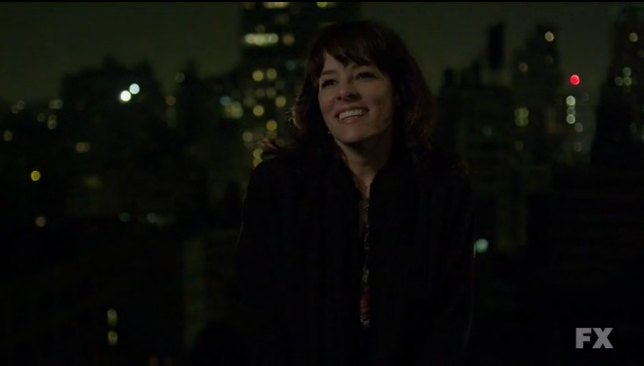
Much has been made of Louie's unpredictability, but perhaps more notable is the rate at which its experiments succeed–particularly successful this year were the two-parter co-starring Parker Posey and the Late Show triple-header featuring a typically enigmatic performance from David Lynch. C.K.'s presence will be missed on television screens in 2013.

1. Mad Men (AMC)
The run of episodes in Mad Men's Fifth Season stretching from "Mystery Date" to "Dark Shadows"–each possessing the depth, scope, richness, and poignancy of feature films–could be the strongest in television history. "Christmas Waltz" provides a brief respite before plunging the audience into the depths of despair via "The Other Woman" and "Commissions and Fees." Following a seventeen month hiatus, Matt Weiner and company are still aeons ahead of their peers, finding new ways to improve on perfection with each successive season, crafting what may well be the greatest show of all time.

Monday, December 3, 2012

2012 Year-End Coverage


This post is intended as a catch-all for 2012 year-end coverage that will dominate proceedings here for the month of December. New posts will be appearing every Thursday.
Check back and enjoy.

Saturday, November 17, 2012

The Master (Paul Thomas Anderson, 2012)


Previously published in slightly different form in The Cube.

“Man is not an animal,” states Phillip Seymour Hoffman’s Lancaster Dodd. Freddie Quell, portrayed in a career-defining turn by Joaquin Phoenix, seems willed into existence to challenge that belief. A pugnacious vagabond with a predilection for toxic alcoholic concoctions, Quell is a ball of twitchy-nervousness and repressed feelings that externalize themselves in his contorted posture and persistent sneer.  Meanwhile, Hoffman brings Dodd to life with a distinctly Wellesian theatrical air. He is a man always aware of his audience, even when alone.  The performances—like the characters—are a study in contrasts; this dichotomy is expertly visualized midway through the film in an excruciatingly long take that uses a dividing wall as a makeshift split-screen, observing the opposing reactions the characters exhibit when presented with the same predicament.

The contrapuntal relationship between these men is at the film’s heart. Lancaster Dodd is the titular “Master,” the figurehead of a burgeoning religion or, if you are feeling less charitable, cult. Freddie quite literally stumbles into his wake and is quickly swept away. The magnetism that develops between them in Freddie’s first “processing” session is such that the viewer cannot help but submit to its attraction. Dodd sees in Freddie’s mania something of an acid test for his crackpot theories, and Freddie, a man who has lived his entire life held at an arm’s length by others, is mesmerized by the constant attention Dodd bestows upon him. The latest in a chain of surrogate father-son relationships that populate the films of Paul Thomas Anderson, it serves to both fuel and undermine the characters while inspiring concern in Dodd’s wife.

Anderson’s last film, There Will Be Blood, was widely considered one of the best films of the previous decade, and the intervening five years—rife with production disputes, financiers backing out, etc.—have created a wave of anticipation for The Master. If it does not appear to reach the heights of its predecessor, it is likely because Anderson has forgone the spectacular set pieces of previous films in favor of a quieter style that is less cathartic. Intimate close-ups wrench every ounce of emotion from the actor’s faces, while patient wide shots relate the rare bursts of action. This strategy conveys the cast’s performances to the audience as transparently as possible without ceding directorial authority. Beautiful cinematography, seamless editing, and a disconcerting score, courtesy of Radiohead’s Jonny Greenwood, make it all appear effortless.

Much has been made of the film’s roots in the history of Scientology, and while that is undoubtedly a factor, Anderson has greater aims. A film satirizing or condemning the contentious religion would have been much easier to conceive but resulted in a lesser artistic expression. Anderson’s masterstroke is humanizing Lancaster Dodd, seeing in him a long line of charlatans, showmen, and hucksters who have populated the American landscape and captivated its imagination. Scientology’s L. Ron Hubbard is only the most imposing of these men who believe—or at least profess to believe—they possess the cure to the nation’s spiritual ills.

In this sense, The Master is a markedly modernist work, tracking Dodd’s tortured Superego as it attempts to tame the unruly postwar American Id as manifested in Freddie Quell. Amy Adams, as Dodd’s wife, attempts to play the role of the Ego, but never manages to do more than delay the growth of the malignant codependency developing between the two.  It is a metaphor for the film itself, the epic, self-assured filmmaking struggling to come to terms with the messiness of the personalities on display. In fact, the most common complaint likely to be leveled at the film is that, within this metaphor, it lacks an effectual Ego in the form of a recognizable narrative structure. Nonetheless, it is an example of an artist in complete command of his craft; just don’t go in expecting easy answers, The Master doesn’t have them.